From Grove to Press: Our Harvest with Naturvie
There are some things you can understand perfectly well in theory, and then there are the things you only really understand once you have stood in the middle of them.
Last week, we travelled to Extremadura to spend time with Fernando and his family at Naturvie during the olive harvest. We have known their oil for some time. We know where it comes from, the varieties they grow and the care that goes into making it. But being there, with the harvest happening around us, changed our appreciation of it completely.
This was not a visit from a distance. We joined in.
We picked olives from the trees, followed them into the mill and through to pressing. To see that journey happen in front of you, from fruit hanging on the tree to fresh Extra Virgin Olive Oil, is quite something. To actually take part in it, even for a short while, is something else entirely.
There is a physicality to harvest that is easy to forget when you pick up a bottle from a shelf. The trees, the weather, the timing, the endless small decisions. Fruit has to be picked at the right moment, handled carefully and pressed quickly.
Quality is not something that is added at the end. It is protected at every stage.
That was perhaps the thing we came away understanding most clearly.

Fifteen varieties and no standing still
Fernando grows and works with around 15 different olive varieties, and is constantly experimenting with them.
Some will work beautifully as single cultivar oils. Others come into their own as part of a blend, bringing fruit, bitterness, aroma or pepper in different proportions. The aim is always the same: to make the best oil possible from the fruit and the harvest in front of him.
That curiosity is infectious.
Rather than settling on a formula and repeating it, Fernando keeps tasting, testing and learning. Different cultivars, different combinations, different harvest points. There is always another possibility to explore.
It is one of the things that makes us particularly excited about where our relationship with Naturvie might go next. We hope to introduce some new oils from them next year, including the opportunity to explore both new blends and single cultivar Extra Virgin Olive Oils.
The passion behind all of this is impossible to miss.
Fernando knows the trees, the land and the oil intimately. Much of the grove includes old trees, some around two centuries old, but Naturvie is not a business looking backwards. There is a real sense of experimentation and progress alongside that respect for the land.
And it is very much a family affair.
Two of Fernando’s children, both in their twenties, joined us during the harvest. There was something quietly moving about seeing the next generation there, working amongst the same trees and sharing in something that clearly means so much to the family.
Fernando put it rather beautifully afterwards. He told us how important it was to see the faces behind the emails and to remember that behind every bottle there are people working, olive groves to cultivate and something very real behind it all.
That stayed with us.
There is a great deal of talk in food about provenance. Sometimes it risks becoming little more than a word on a label.
Standing in the grove makes it real.
You see who grows the food. You see the decisions they make. You see how much work is involved before anything reaches a bottle. And suddenly the oil on the table represents much more than simply an ingredient.

If Fernando were a winemaker...
During the visit we also had the great pleasure of tasting olive oil with Alfonso J. Fernández of Extra Virgin Solutions, a highly experienced olive oil professional and, importantly, a close friend of Fernando.
We tasted through different oils and talked about cultivars, blends, balance and what separates a good Extra Virgin Olive Oil from a truly memorable one.
And Alfonso said something that has stayed with us ever since:
“If Fernando were a winemaker, he would be famous.”
It was one of those remarks that manages to explain a great deal in very few words.
With wine, we instinctively understand the importance of the grower. We talk about grape varieties, vintages, vineyards, soil, weather and the decisions made by the person producing it.
With Extra Virgin Olive Oil, that same level of craftsmanship is often hidden behind the category itself.
Yet spend a day with Fernando and the parallels are obvious.
The cultivar matters. The land matters. The weather matters. The timing of the harvest matters. How quickly the fruit reaches the mill matters. The blend matters. And above all, the judgement of the person making the oil matters.
Working with 15 olive varieties gives Fernando a remarkable palette to work from. Much like a winemaker deciding which grape varieties to bottle alone and which to bring together, he can explore what each cultivar contributes and how they behave from one harvest to the next.
No two years are quite the same.
That is part of the fascination.

Olive oil as part of the pantry
One of the most interesting parts of the tasting was hearing Alfonso talk about how different oils should actually be used.
His view was very simple: Extra Virgin Olive Oil should be thought of rather like a spice.
Not every oil suits every dish.
One might be particularly good with fish. Another might work beautifully with fruit. A greener, more peppery oil might suit beans, tomatoes or grilled vegetables. A softer, rounder one might be the better choice for baking, roasting or something delicate.
The idea that there should be one bottle of olive oil in the kitchen for every possible job suddenly starts to feel rather limiting.
Instead, Alfonso talked about having several different oils to hand, much as you might keep different spices in the cupboard and choose between them depending on what you are cooking.
That is an idea we love.
It also speaks to something we have always believed: good Extra Virgin Olive Oil is not something to save only for dressing a finished plate.
It should be cooked with.
Use it for roasting. Use it in a pan. Use it in marinades. Use it in sauces. Bake with it. Dress with it. Finish with it.
The point is not to be precious about good oil, but to understand it well enough to use it properly.
Once you start thinking that way, different cultivars become much more interesting. Instead of asking simply which oil is “best”, the better question becomes:
Best for what?
That is perhaps where olive oil has the most to learn from wine.
Not every bottle has to do the same job.

Fresh from the press
There is also something extraordinary about tasting oil almost as soon as it has been made.
Fresh Extra Virgin Olive Oil has an energy that is difficult to describe until you have experienced it. Fruitiness, bitterness and pepper are all there, but so is a vivid greenness and freshness.
It feels alive.
Having picked some of those olives ourselves earlier in the day made the experience surprisingly emotional.
We have worked with olives and olive oil for a very long time, but there is always more to learn. Taking part in the harvest left us with an even greater appreciation of just how much knowledge, work and judgement sits behind a genuinely good bottle of Extra Virgin Olive Oil.
It also reinforced something we increasingly believe matters in food.
Know the people who make it.
For us, that is one of the great privileges of working with producers such as Naturvie.
There is a family behind the oil. There are groves to tend. There are harvests that change from year to year. There are experiments that work and others that lead to the next experiment. And there is an enormous amount of passion.
Fernando ended his note to us after the visit by saying he was sure there were many more opportunities for us to explore together.
We very much hope so.
Next year, we hope that might mean introducing some of those other cultivars and oils to the Olives Et Al table.
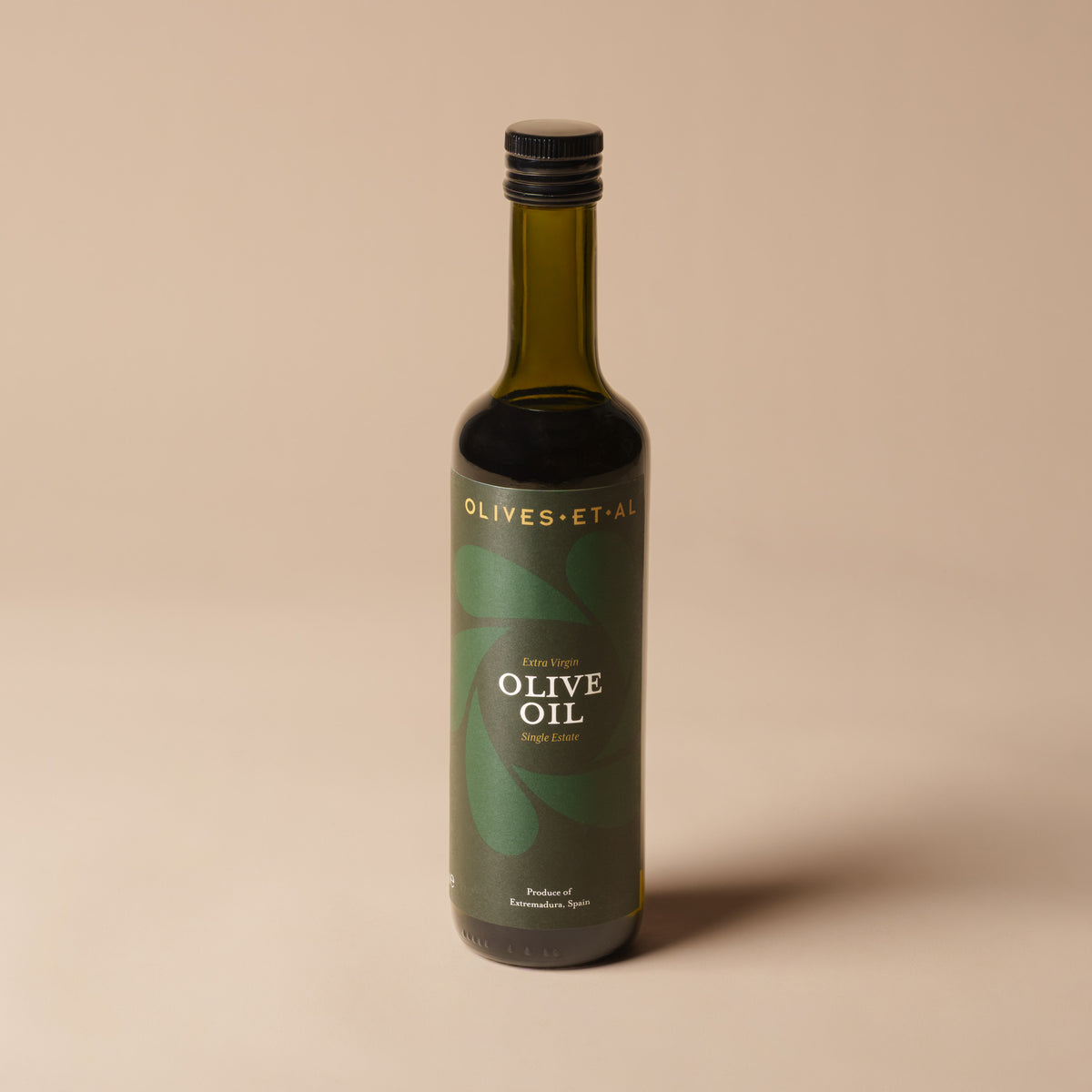
For now, when we reach for our House Extra Virgin Olive Oil, we will see it rather differently.
We will think of Extremadura. Of Fernando and his family. Of olives coming off the trees. Of pressing them and tasting the first fresh oil.
And of Alfonso’s words.
If Fernando were a winemaker, he would be famous.
Perhaps it is time we started talking about great olive oil producers in much the same way.
And perhaps it is time we started using great olive oils that way too: not as one bottle for everything, but as a pantry of flavours, chosen according to what is on the stove and what is about to arrive at the table.